


April 30, 2026
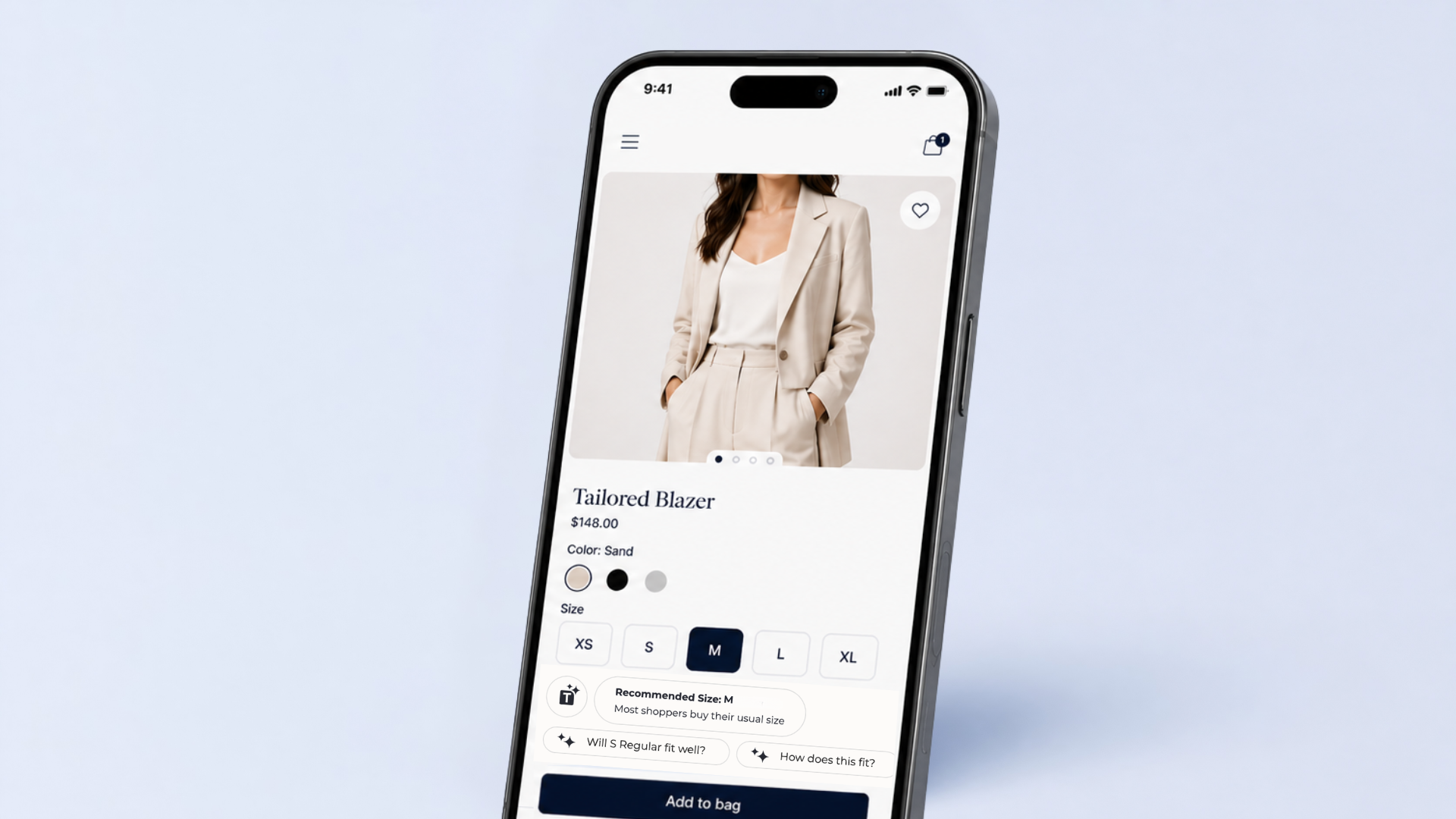
Every apparel product page has the same moment of friction. The shopper has scrolled the photography, read the reviews, picked a color, and decided to buy. Then they hit the size selector, and they stop.
Some abandon. Some order two sizes. Some order one and return it. All three are expensive.
The usual investments don't reach that moment. A better size guide sits below the fold and rarely gets opened. A cleaner return policy helps after the purchase, not before. Customer review widgets describe what past shoppers thought, which is closer but still generic. None of them tell this shopper, in this brand, in this specific style, what size to order.
Digital fitting is the technology built to answer that question. This post explains what it is, how it works at the data layer, what separates the platforms that move the needle from the ones that don't, and what apparel and footwear retailers are seeing when they implement it.
Digital fitting is the use of AI and shopper data to recommend the right size for a specific shopper in a specific product, at the moment of purchase. It replaces the guesswork at the size selector with a personalized recommendation built on real purchase and return outcomes.
It's worth being specific about what it replaces, because retailers often confuse digital fitting with three things already sitting on most product pages.
It is not a size chart. A size chart measures the garment. It tells the shopper the chest is 20 inches. That's a different answer to a different question than the one the shopper is asking, which is what size to order.
It is not a self-report quiz. Quizzes that ask the shopper to enter their height, weight, and body type depend on the shopper already knowing things they don't. The shoppers most confused at the size selector are the ones who can't answer "what size are you usually?" with any confidence. An algorithm built on self-reported inputs fails hardest where it's needed most.
It is not a "true to size" review widget. Crowd-sourced fit sentiment is useful color, but it's an average across every shopper who bought the item, not a recommendation for the specific shopper on the page. A shopper with a slim build and a relaxed fit preference needs different guidance than a shopper with the opposite profile. Averages don't deliver that.
Digital fitting works from observed shopper outcomes across thousands of brands. The output is a single, confident size recommendation for that shopper, for that product, on that product page. The point is to eliminate the moment of uncertainty that drives bracketing, abandonment, and returns.

The most important distinction in digital fitting is the difference between outcome data and intent data.
Intent data is what shoppers click, browse, search, add to cart, or self-report in a quiz. It's what most personalization systems run on because it's what retailers can collect from their own traffic. The problem with intent data for fit is that a shopper's clicks and self-reports often reflect what they want to be true, not what actually fits them. Someone who thinks of themselves as a medium adds medium to the cart. Whether the medium actually fits them isn't in that signal.
Outcome data is what shoppers kept. It's the other side of the transaction: the purchases that didn't come back. A shopper who bought a medium and kept it is a data point about what fits that shopper. A shopper who bought a medium and returned it is a different data point, about the same shopper. Neither is a guess. Both are observed.
True Fit's fit intelligence is built on nearly 20 years of this kind of outcome data: real purchase and return behavior from 100 million+ shoppers across 91,000+ brands, covering 60 million unique products and $616 billion in transactions. Every recommendation the platform produces is read against what shoppers in comparable situations actually kept. The signal is what they did, not what they said.
When a shopper reaches a product page, True Fit maps their personal purchase and return history to the brand and style they're looking at. If the shopper has kept a medium in three athletic brands with similar fit characteristics, and is now on a page for a fourth brand with comparable fit characteristics, there's a real basis for recommending medium. The recommendation isn't derived from a self-reported measurement or from browsing behavior. It's derived from what shoppers with comparable purchase histories actually took home and didn't return.
For returning shoppers, the profile updates with each purchase, making recommendations more accurate over time. For new shoppers, the platform draws on aggregate outcome patterns from comparable shoppers to produce a starting recommendation that improves as the shopper's own history builds.
This is what separates data-led digital fitting from everything else on the market. A recommendation engine built on self-reported inputs produces generic guidance. A recommendation engine built on clicks and carts produces guidance about what shoppers thought they wanted. A recommendation engine built on outcomes produces guidance about what actually fit.

The size selector is the moment everything downstream depends on. Conversion, return rate, repeat purchase, and lifetime value all trace back to whether the shopper made a confident decision at that moment.
A shopper who isn't confident about their size has three options: abandon the page, order one size and hope it fits, or order multiple sizes and return whichever ones don't. All three outcomes are worse than a confident single purchase. Abandonment loses the sale. A wrong-size order generates a return. Multiple sizes generate multiple returns. None of these outcomes are what the retailer or the shopper wants.
The downstream investments retailers make to manage these outcomes (better return portals, improved size guides, more detailed product photography) address the consequences of the confidence gap rather than the gap itself. Faster refunds and easier returns reduce the cost of a return. Only a pre-purchase intervention reduces the volume of returns. That's the distinction that actually moves return rate.
Digital fitting addresses the gap directly. When a shopper reaches the size selector with a confident recommendation built on their own purchase history and the brand's outcome data, the downstream outcomes change. True Fit shoppers convert at 2 to 4 times the rate of non-users in the same stores. That differential is what happens when the confidence problem is solved before the add-to-cart decision.
For retailers investing in conversion rate optimization, this matters. The conversion lift from digital fitting is not from improved UX or faster load times or better photography. It comes from giving the shopper an answer to the question they were stuck on.
PacSun's team noticed something in their chatbot logs. The single most common question shoppers were asking wasn't about shipping, inventory, or returns. It was how to decode their size chart.
That volume of inbound sizing questions is a direct measure of the confidence gap in a shopper experience. Every one of those chatbot conversations was a shopper who stopped at the size selector, couldn't find a confident answer, and had to ask a person. The ones who asked were the visible portion. The larger group, the shoppers who didn't ask and instead abandoned or ordered two sizes, was invisible in the data but equally real.
PacSun implemented True Fit to close the gap at the product page itself. Instead of sending confused shoppers to a chatbot or a size chart, the platform delivered a personalized size recommendation in the size selector, calibrated against what similar shoppers had bought and kept across PacSun's brand mix.
The outcomes were material. Conversion rate on PDPs where True Fit was active more than doubled, landing at 12.9%. True Fit shoppers, the subset engaging with the recommendation, drove a 4.71% incremental revenue lift sitewide. The chatbot traffic for sizing questions dropped, because the question was being answered before it needed to be asked.
What's worth pausing on is the mechanism. Traffic didn't change. The same shoppers who had been landing on PacSun product pages before implementation were landing on them after. What changed was that the subset of those shoppers who had been abandoning at the size selector, or bracketing, now had an answer and bought.
The PacSun mechanism replicates. ASICS saw a 150% increase in PDP-to-cart conversion after implementation. Forever New, the Australian fashion retailer, saw a 6.22% incremental revenue lift. APL reduced fit-related returns by 15%. Different catalogs, different geographies, same throughline: when the confidence problem is solved at the size selector, both conversion and returns improve together.
The confidence problem at the size selector doesn't stay on the product page. It follows the shopper wherever they make decisions, and increasingly, that's outside the retailer's site entirely.
AI shopping agents are becoming a mainstream part of how people discover and evaluate products. When a shopper asks an agent to find trail shoes or a winter coat, the agent has to make a decision about fit. That decision happens whether or not the agent has reliable fit data to work from. Agents don't go silent when fit data is missing. They make their best guess, confidently, and the retailer never sees the miss.
This is not a discovery problem. It is a decision problem. The moment of decision, the point where uncertainty either resolves or persists, is the only moment that changes the outcome. In agentic commerce, that moment is no longer guaranteed to happen on a product page.
True Fit's Fit Intelligence Layer is built for this use case. It makes decision-grade fit data available to AI agents through a standard protocol. The same outcome-grounded recommendations that improve conversion on the PDP extend into the channels where the next generation of retail discovery is happening.
Nearly 20 years of real purchase and return data, spanning 100 million+ shoppers and 91,000+ brands, isn't something an AI agent can approximate from product descriptions or publicly available size charts. It's intelligence built on what shoppers actually did, not what they said, and it travels with the shopper wherever they're making decisions.
For retailers thinking about where fit technology is going, the question is no longer only how digital fitting performs on your PDP today. It's whether your fit data is ready to travel.
Want to go deeper on fit intelligence in the age of agentic commerce? Download the Fit Intelligence Layer playbook to see how retailers are turning agentic interactions into a decisioning conversion engine.
Digital fitting is the technology that solves the confidence problem at the moment it matters most: the size selector, on the product page, before the shopper clicks add to cart. It works from observed outcomes at scale, not from size charts, self-reported quiz answers, or crowd-sourced fit sentiment.
Retailers who implement it see a consistent pattern: higher conversion, lower return volume, and higher repeat purchase. The mechanism is straightforward. When shoppers make confident size decisions, they buy more and return less.
What separates the platforms that produce those outcomes from the ones that don't is the underlying data. Intent data, what shoppers clicked, browsed, or self-reported, will get a platform to a recommendation. Outcome data, what shoppers actually kept, is what makes the recommendation right.
Want to see how digital fitting works for your catalog? Request a demo at truefit.com/get-started and we'll show you how True Fit's fit intelligence maps to your product catalog and shopper base.
Digital fitting is the use of AI and real purchase and return data to recommend the right size for a specific shopper in a specific product at the moment of purchase. It replaces the static size selector with a personalized recommendation grounded in observed shopper behavior across thousands of brands.
A size chart provides garment measurements. Digital fitting provides a personalized size recommendation based on what similar shoppers bought and kept across the brands they shop. A size chart tells the shopper a measurement. Digital fitting tells the shopper which size to order.
True Fit's digital fitting platform is built on nearly 20 years of real purchase and return outcomes from 100 million+ shoppers across 91,000+ brands and $616 billion in transactions. Recommendations are calibrated against that outcome history, not against self-reported measurements or publicly available size charts.
Yes. True Fit's platform covers both apparel and footwear. ASICS saw a 150% increase in PDP-to-cart conversion after implementing digital fitting for footwear. APL reduced fit-related returns by 15%. True Fit's outcome data spans both categories across 91,000+ brands.
Results vary by retailer, catalog, and implementation, but outcomes across True Fit's retail network are consistent: higher conversion rates, lower return rates, and increased repeat purchase. True Fit shoppers convert at 2 to 4 times the rate of non-users in the same stores. PacSun saw their conversion rate more than double to 12.9%. Forever New saw a 6.22% incremental revenue lift. APL reduced fit-related returns by 15%.
In agentic commerce, the decision moment, the point where a shopper's uncertainty resolves or persists, is no longer guaranteed to happen on a product page. AI shopping agents make fit decisions whether or not reliable fit data is available, which means fit intelligence needs to travel with the shopper beyond the PDP. True Fit's Fit Intelligence Layer makes its decision-grade fit data available to AI agents through a standard protocol, extending the same outcome-grounded recommendations that lift PDP conversion into the channels where the next generation of retail discovery is happening.
How it works: True Fit's fit intelligence platform
https://www.truefit.com/how-it-works
PacSun case study: how digital fitting more than doubled conversion rate
https://www.truefit.com/case-studies/pacsun
Forever New case study: 6.22% incremental revenue lift from fit intelligence
https://www.truefit.com/case-studies/forever-new
True Fit and agentic commerce: fit intelligence for AI shopping agents
https://www.truefit.com/agentic-commerce